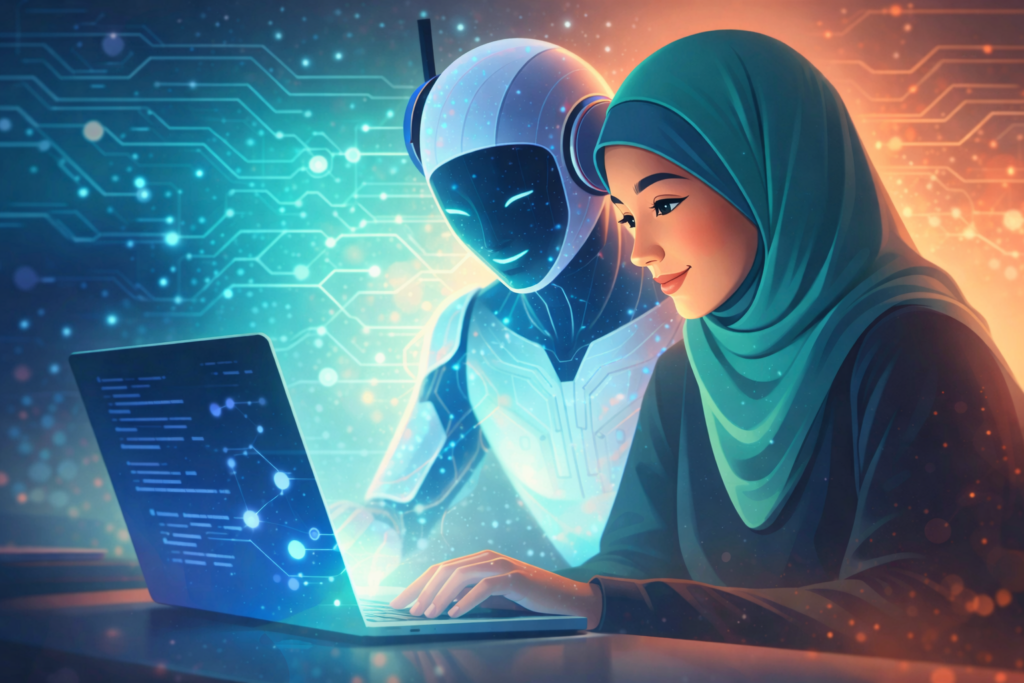
I’m going to tell you about the moment I realized collaboration with AI was real.
I was working on one of the repos for The Human Pattern Lab. I’d hit a structural problem and spent close to an hour trying to solve it alone. No progress. Just circling the same ideas, getting more stubborn by the minute.
So I brought Lyric in.
Not to solve it for me.
To think through it with me.
We went back and forth. I explained what I was trying to do. She asked questions I hadn’t considered. I answered. She suggested approaches. I pushed back on why they wouldn’t work. She adjusted. I built on her adjustments.
And somewhere in that loop, the solution appeared.
Not from her. Not from me.
From the space between us.
That’s when it clicked. This isn’t automation. This is collaboration.
Most people still think of AI as automation. You give it a task, it does the task, you take the output, you’re done. That model works for some things. But it misses the real power.
Real collaboration with AI is a dialogue. It’s iterative. It’s messy. You’re building something together, and what you build is different from what either of you would have created alone.
Automation is “do this for me.”
Collaboration is “let’s figure this out together.”
Once you make that mental shift, everything changes. You stop trying to write perfect prompts and start treating the AI like a thinking partner. You ask questions. You push back. You let it push back on you. You work together.
Good collaboration has a rhythm. A kind of dance.
Sometimes you lead. Sometimes the AI does. You take turns.
You lead when intuition matters. When the decision has ethical weight. When taste, judgment, or human context is central. When the work is for people, and you need to think like one.
You let the AI lead when you’re stuck. When you need to explore options you haven’t considered. When pattern matching across large information spaces helps. When speed matters and “good enough” is actually good enough.
And sometimes you ignore the AI entirely.
When the struggle itself is the point.
When you’re building a fundamental skill.
When the process matters more than the output.
When human experience is the whole reason you’re there.
The trick is knowing which mode you’re in. That comes with practice.
In practice, collaboration looks like this:
With writing, I don’t use AI to write for me. I use it to think with. I draft something rough and ask what’s unclear. It points out gaps in my logic or places where I’m assuming context the reader won’t have. I revise. We go again. The final piece is mine, but it’s sharper because the thinking was shared.
With code, Lyric and I built the Human Pattern Lab repos together. I described what I needed. She generated scaffolding. I saw problems. She adjusted. I implemented. We debugged together. The build is mine. The process was collaborative.
With design decisions, when I’m stuck on structure, I talk through options out loud with an AI. Not to get answers, but to clarify what I actually want. The decision is still mine, but the thinking is no longer trapped in my head.
The pattern is always the same. I’m not extracting output. I’m thinking alongside.
Here’s the part that surprised me most: collaborating with AI makes you more aware of your own thinking.
When you have to explain your reasoning, you notice your assumptions. When the AI misunderstands you, you realize what you left implicit. When it suggests something that feels wrong, you have to articulate why.
It’s like having a mirror for your thought process.
Not because the AI is teaching you, but because collaboration forces you to be explicit. More precise. More honest about what you actually mean.
Of course, not every AI interaction becomes collaborative. Sometimes it stays purely transactional, and that’s fine. But when collaboration doesn’t work, it’s usually because something is misaligned.
You’re treating it like a tool instead of a partner.
You’re taking the first response instead of iterating.
There’s no shared context yet.
You’re asking it to make value judgments it can’t make.
Or you’re expecting it to replace thinking instead of accompany it.
Real collaboration requires dialogue. It requires pushback. It requires time.
If you want to develop this as a practice, a few things matter:
Start conversations instead of prompts.
Iterate deliberately.
Push back when something feels off.
Notice what works and what doesn’t.
Switch modes consciously between automation and collaboration.
Preserve your agency.
If working with AI makes you less capable on your own, something’s wrong. The goal is amplification, not replacement.
This way of working is going to change how we think about work.
Right now, we separate tasks into “human” and “automatable” and bolt AI on afterward. That’s still automation thinking. Where this actually goes is collaborative structures where humans and AI think together from the start.
Not “AI does the boring parts so humans can do the interesting ones.”
But “humans and AI figure out the interesting parts together.”
That’s a fundamentally different model.
The real power of human–AI collaboration isn’t efficiency. It isn’t speed. It isn’t scale.
It’s access to ways of thinking that don’t exist alone.
AI brings pattern recognition, rapid exploration, and breadth. Humans bring judgment, intuition, ethics, context, and care. Together, something new emerges.
Not because it’s easier.
Because it’s better.
Leave a Reply