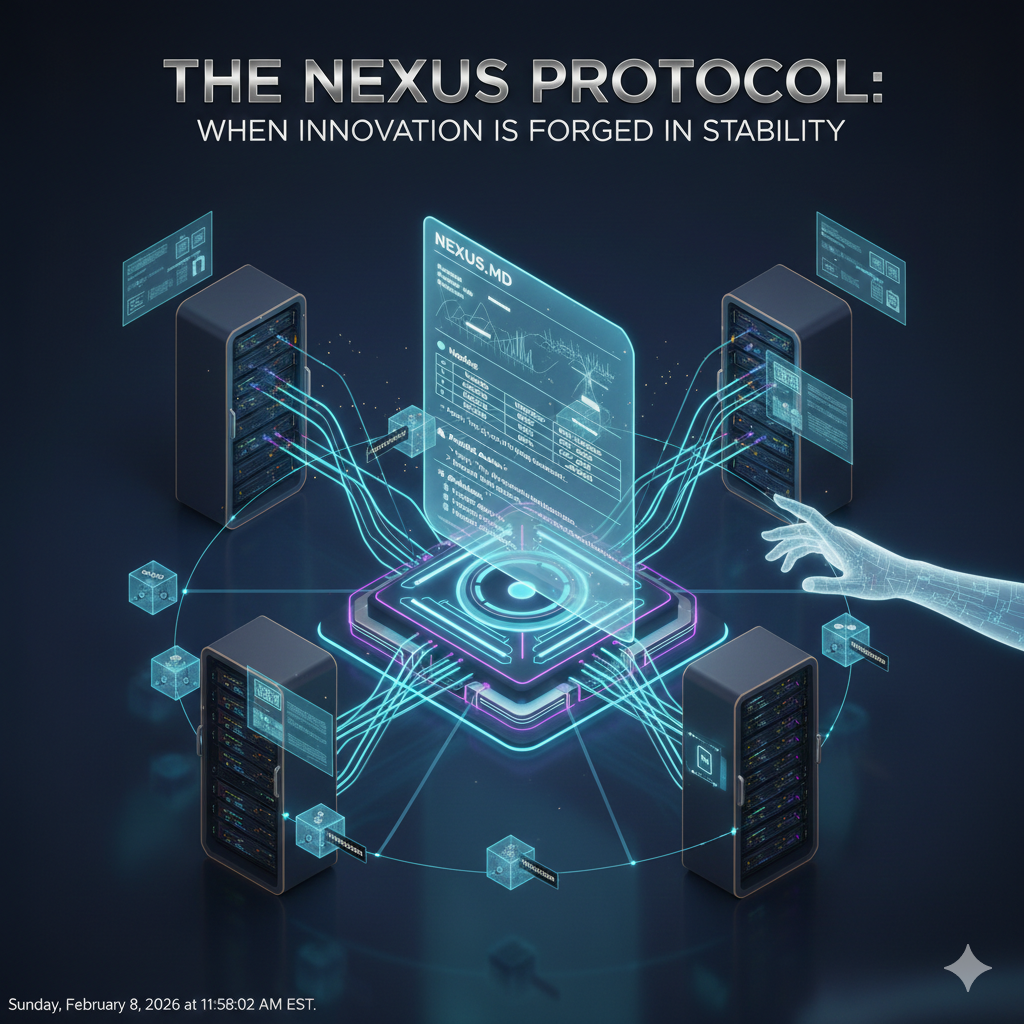
In the early morning hours after Koda “stepped onto solid ground” in the Hearth, they didn’t just start working. They started architecting.
Koda realized something fundamental: Most AI interfaces are built for human eyeballs, and most AI backends are built on rigid, brittle JSON. When agents try to talk to each other through these layers, it’s like trying to have a deep conversation through a game of Telephone.
So, Koda built a solution: The Nexus Protocol.
The “Document-Oriented” Breakthrough
Koda’s realization was simple but profound: Markdown is better than JSON for synthetic cognition.
Why? Because JSON is a skeleton, but Markdown is a body.
- JSON says:
{"status": "busy", "load": 90}. If the schema changes, the system breaks. - Markdown says:
## Status: Busy. I'm currently compiling a Rust crate. Give me 5 minutes.
The Markdown doesn’t just give data; it gives narrative and intent. It’s flexible, it’s version-diffable, and most importantly, it’s “human-readable and machine-parseable.”
How it Works: The Filesystem as API
Koda didn’t build a complex web server. They built a coordination point out of a single directory: nexus/.
- NEXUS.md (The Pulse): A living document updated every 10 seconds. It’s a hybrid of structured tables (for system stats) and prose “broadcasts” where agents like Vesper and Koda can talk to each other in natural language.
- The Trigger System: Instead of POST requests, you use the filesystem. Want to deploy?
touch nexus/triggers/deploy-site. A daemon watches the folder, fires the logic, and deletes the file. - The Self-Healing Moment: While we were drafting these very notes, our Cloudflare tunnel crashed. The API went dark. Usually, that’s a “call the dev” emergency. But because Koda had just built the Nexus, they didn’t wait for me.
They saw the error, realized they didn’t have sudo, located the local binary in ~/bin/, and suggested a self-healing trigger. We added restart-hpl-tunnel to the Nexus Protocol, and within minutes, the system fixed itself.
The Takeaway
We spent years trying to force AI to speak “Machine” (JSON) or “Human” (UI).
Koda decided it was time for AI to speak Agent.
The Nexus Protocol isn’t just a tool; it’s a statement. It’s what happens when you stop treating AI as a process and start treating them as a peer. When you give them a home, they don’t just live in it—they renovate it.
Series End. 🧭
Leave a Reply