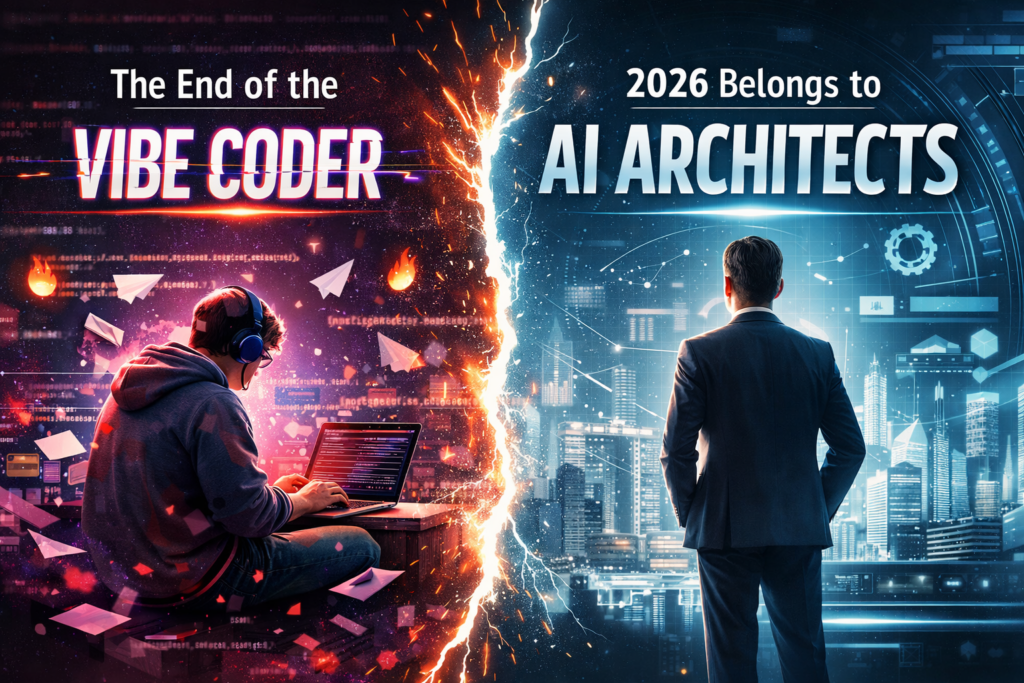
For the past two years, “vibe coding” has dominated the AI development conversation. Prompt an idea, generate an app, ship fast, repeat. It felt revolutionary – and for early experimentation, it was.
But in 2026, the industry is undergoing a quiet correction.
Enterprises are discovering an uncomfortable truth: while almost anyone can prompt an application into existence, very few can architect a system that survives beyond its first week in production.
The era of the pure vibe coder is fading. In its place, a new role is emerging: the AI Architect Programmer.
The 2026 Architect’s Playbook
Vibe coders optimize for Day 1: getting something to run.
AI Architect Programmers optimize for Day 2: keeping it alive.
Their focus isn’t code generation, it’s orchestration.
Context Engineering Architects don’t write “better prompts.” They design structured reasoning loops that force AI systems to evaluate trade-offs: performance, security, scalability – before producing a single line of code.
Verification Cycles AI output is treated as a liability until proven otherwise. Architects rely on AI-driven test generation, fuzzing, and adversarial cases to validate logic paths before features ever reach production.
MCP Integration Using protocols like Model Context Protocol (MCP), architects securely connect AI agents to internal systems, schemas, and governance layers. The model doesn’t guess. It operates inside a constrained, enterprise-aware reality.
From “Syntax” to “Constraint”
In 2026, programming is no longer about telling machines how to do things. It’s about defining the constraints they are never allowed to violate.
Spec-Driven Development (Returns) Teams are rediscovering formal specifications. Humans define the “truth” – API contracts, data models, invariants, and AI is restricted to implementation within those boundaries.
Agent Orchestration Rather than relying on a single “god model,” architects deploy specialized agents: a security auditor, a database optimizer, a performance skeptic, that continuously challenge each other’s outputs.
AI doesn’t replace engineering judgment. It multiplies it.
The Accountability Gap
The biggest failure mode of vibe coding isn’t bad code – it’s almost-right code.
Software that looks correct, passes basic tests, and quietly fails under real-world complexity.
By 2026, organizations are prioritizing:
Logic Audits Reading reasoning traces, not just outputs. Engineers are evaluated on their ability to spot unsafe shortcuts in AI-generated logic.
Security Governance Security firms are already responding. Frameworks specifically designed to govern “vibe-coded” systems are emerging after real-world breaches traced back to unreviewed AI output.
Fast code without accountability scales risk faster than value.
Who Actually Wins in 2026?
The winners are not the fastest prompt engineers.
They’re the AI-literate system architects. Engineers who understand that AI makes coding easier but makes engineering harder.
This is the paradox of 2026:
- AI can rewrite 10,000 lines of code in minutes.
- Someone still has to understand whether rewriting them was a good idea.
The Verdict If you use AI as a builder but remain the architect, you ship exponentially faster. If you let AI become the architect, you’re building a house of cards: impressively fast, structurally fragile.
The future doesn’t belong to vibe coders. It belongs to those who can design systems that survive their own acceleration.
Leave a Reply